פתח תפריט ניווט

קטגוריות ראשיות

Morel SOPRAN

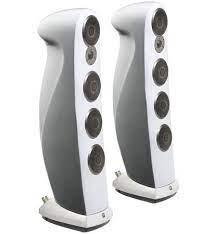
עכשיו בפיוצ’ר – זוכה הפרס היוקרתי לחדשנות ועיצוב לשנת 2013 של תערוכת CES היוקרתית בעולם בתחום זה.הסופרן הוא רמקול ריצפתי ביתי הנחשב למפגש פסגה בין עיצוב לאיכות שמע מהטובות בעולם. הסופרן תוכנן כרמקול High end ללא פשרות מכף רגל ועד ראש, בעל יכולות אקוסטיות בלתי מתפשרות המעניקות למאזינים את הריגוש, הדרמה וההתלהבות שיש בהופעה חיה וכל זה לצד מראהו המעוצב והמוקפד שאינו משאיר אף אחד/ת אדיש לכך.

הסופרן פותח בהשראת רמקול הדגל של חברת מוראל גם כן מתחום הבית ה- fat lady),) ומתאפיין בתיבה מחומרים אקזוטיים במיוחד שהדומיננטי שבהם הוא CARBON FIBER (סיבי פחמן) דבר המוסיף תכונת אופי מעניינת במיוחד לרמקול המייצרת שקיפות לצלילים הבוקעים ממנו בשעת ניגון, ובעקבות שקיפות זו “הרמקול כביכול נעלם” ונשארת המלודיה, כלי הנגינה והזמרים בחלל החדר כאילו הם עצמם שם.

בתוספת המילה האחרונה בטכנולוגיות של מוראל: דרייבר "6 בעל מנגנון תמיכה מטיטניום ל-voice coil המעביר את הכח המוטורי לממברנה עם אנרגיה מינימאלית על מנת לשמר את הדינמיקה של הצליל המקורי.

ניתן להשיגו בגימור פיאנו מבריק בצבע לבן או שחור.

קרדיט:

When Morel’s Fat Lady (reviewed by JV, Issue 209) touched down on North American shores in 2009, few could accuse the Israel-based company of lacking a sense of humor. The high-tech flagship with its robust, operatic curves was aptly named, and much to Morel’s delight people were soon remarking, “It ain’t over until the Fat Lady sings.” For sing she did, and eloquently, with every carbon fiber of her voluptuous enclosure. Except, it wasn’t over. Not by a long shot. It turns out that the Fat Lady has family in the form of the Sopran, Morel’s slimmer follow-up. In fact the Sopran reflects the same showcase technologies that vaulted the Fat Lady to prominence—albeit at roughly one-third the cost.

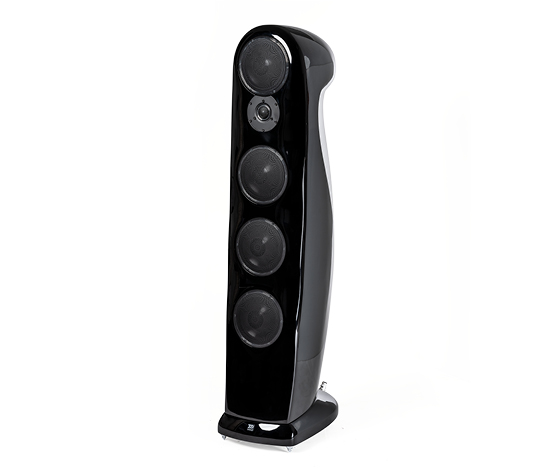
While this five-driver, bass-reflex floorstanding design doesn’t make quite the same entrance as the head-turning Fat Lady, its fluid, contemporary looks are similarly unforgettable. The Sopran silhouette is absent any sharp corners and represents a complex series of swooping curves that dramatically narrows toward the uppermost portion of the enclosure and then broadens and deepens into a round top chamber housing the midrange and tweeter drivers (isolated internally in their own sub-enclosure). From the cabinet’s gently sloping front baffle to its ported back, each bend and arch is purposefully executed. It is a key Morel design strategy for diffusing internal standing waves and negating the need for absorptive materials within the enclosure. Morel’s aim is to fine-tune the internal architecture of the cabinet—not unlike the body of a musical instrument—to perform in concert with Morel’s proprietary transducers. The added benefits of the curved surfaces are superior rigidity and a reduction in diffraction. At floor level the cabinet terminates in a textured-leather-covered base, which houses the Sopran crossover, isolating the delicate circuitry from internal backwave pressures during playback—one of Sopran’s advancements over the Fat Lady.

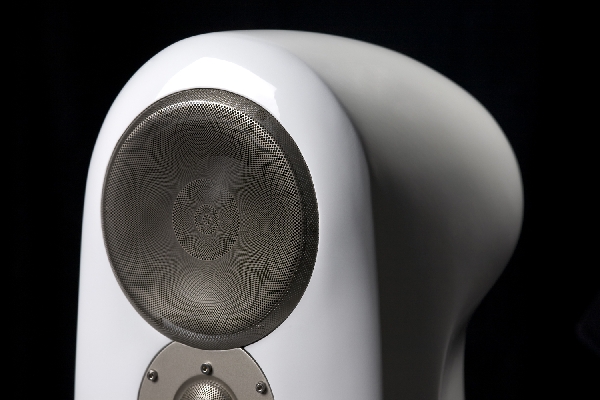
Unlike the naked baffle design of the Fat Lady, the more modest Sopran comes with circular, perforated metal grilles over its transducers. Characterized as more or less acoustically transparent “lotus” designs, they magnetically secure themselves to the outer frame of each driver, and Morel provides a powerful, handheld, circular magnet to aid in their removal. However, while they are attractive in a Zen fashion, they are not “more or less acoustically transparent.” I much preferred listening without them. Indeed, I wondered why the grilles were included at all? In Morel’s view the Fat Lady was for advanced high-enders who like to celebrate the technology—visually as well as audibly. But the “naked driver” approach did have its detractors, so Morel now places the option of grilles or no-grilles squarely in the hands of Sopran owners.
Morel fanciers already know that transducer design is the company’s claim to fame. For the Sopran, engineers developed all-new 6″ drivers that swap the exotic carbon-fiber/Rohacell composite diaphragms of the Fat Lady for more prosaic damped-polymer composites. I was told that to make up for the small loss in diaphragmatic stiffness, Morel opted for titanium (rather than aluminum) formers and thereby gained a degree of lightness. The drivers are each specifically aligned for the volumes they encounter and tuned to their respective ports. The midrange unit sports a large, three-inch voice coil with hybrid ferrite-neodymium magnets surrounded by a full copper ring to reduce eddy-current distortion. The rubber surround has been made lower and narrower, tuned for moderate excursions and flat response. (The woofer’s surround is taller and wider, allowing for the larger excursions that low bass demands.) The tweeter is Morel’s 1.1″ Acuflex soft dome.

The Sound
For prospective owners I should note that the Sopran took a few weeks to break-in, longer than I normally experience. And early on, it did sound a little shouty and lacking in top-to-bottom coherence. However, this changed dramatically—and for the better. (JV reported he had the same experience with the Fat Lady.)

My sonic impression of the Sopran was one of immediacy, laser focus, and stable dynamic energy across nearly the entire audio spectrum. The Sopran doesn’t lay back in a shy or recessive manner—very little in the way of micro-or macro-detail escapes it. Rather its tonal character is more forward and analytical. Its presentation is not unlike the precision of a professional monitor but without the commonly associated mechanical coolness. The Sopran can be sheer magic in the way it responds to music’s colorful palette of dynamic contrasts. I was wowed by just how well the Sopran resolved the harmonic details and resonances of the delicate harp figure that runs throughout The Wasps Overture from the recent Reference Recordings disc. Or, the softly mixed banjo that accompanies the Eagles during the track “Twenty-One” from their Desperado album [Asylum/HDtracks]. This degree of low-level detail and transparency is one of the Sopran’s primary virtues.

The Sopran excels at intimacy. The speaker is preternaturally responsive, so that when Mary Stallings leans into the microphone during “Sunday Kind Of Love” on Live at the Vanguard [Concord], the speaker instantaneously tracks her movement, reflecting the authentic stops and starts of her phrasing without overlaying its own material or electrical colorations. Every gentle pianissimo is just as defined and grounded as the loudest fortissimo.


In my evaluations, solo piano is the crucible upon which loudspeakers ultimately rise or fall. The Sopran rose to the occasion with pristine imaging and a “clean-room” level of spotless resolving power. During Pictures At An Exhibition the lower piano octaves were brilliant, grounded to the earth, and explosive—the piano’s vast soundboard deeply resonating as the pianist’s touch illuminated the shifting dynamics of every chord. Both speed and micro-dynamic definition were superb, each note ringing and decaying at its own unique rate. Even at low levels I could hear the instrument’s soundboard pressurizing the listening space like a huge bellows expanding and contracting.

Tonal balance is for most part very good but there’s one tonal issue where I have a minor disagreement with the Sopran, and I want to get it out of the way early so as not to distract from the excellence going on elsewhere in the loudspeaker. There’s a midrange/lower-treble prominence that pushes performers forward slightly as if applying an acoustic magnifying glass to images, timbre, and transient data. For example during the Jen Chapin’s “You Haven’t Done Nothin’” from ReVisions [Chesky] the sax’s explosive dynamics are exquisitely rendered yet the more forceful upper register creates an overall image that’s less evocative of the larger body of the instrument. During “Song For Bernadette” from Jennifer Warnes’ Famous Blue Raincoat, the strings brighten as do Warnes’ upper-register vocal peaks, adding traces of extra sibilance. Similarly, the upper octaves of the concert grand have a more concussive signature that gives slightly greater prominence to the initial burst of the note than the trailing harmonic resonance emanating from the soundboard. On the one hand, this trait adds sparkle and makes each performance more of an event. On the other hand and this is where my own biases emerge, it removes some of the natural acoustic warmth that underscores live music.

When someone spends as much time in the land of two-way compacts as I do, (and happily so), I have to admit that a lively three-way like the Sopran does have its virtues—particularly in two areas. The first is dynamics. With a dedicated midrange driver in the mix, the benefits redound to all the drivers. Since the tweeter and bass drivers reproduce narrower bands, they more freely operate within their ranges and are less subject to dynamic compression. As a result, the finest recordings simply blossom with macro-and micro-dynamic gradations. Even during an old chestnut like Cat Stevens’ “Where do the Children Play” from Tea for The Tillerman [Island/Acoustic Sounds] I was taken aback by the range of shifting dynamics from the quiet first verse to the emotional plea of the final chorus. Whether it’s tiny light percussion cues like triangles or wood blocks or something much heavier like a kettledrum, the Sopran rewards the ear with the fine timbral distinctions between each struck note. I noted this while keying on the talking drums that underscore the Jennifer Warnes’ track “Way Down Deep.” The Sopran imparted a sort of trampoline effect off the skin of the drum with each impact—a controlled but vibrant “boing” if you will.

The other area of excellence is the quality of bass response. There are none of the gaps or suckouts in the Sopran’s low frequencies that deprive the music of weight, energy, and ambience, sometimes prompting this listener to feather in more volume in a futile attempt to boost output in these octaves. The Sopran’s responsiveness from the lower midrange down to the lower thirty-cycle range is excellent. It’s composed, full-bodied, and articulate, as I found out during “1A”, a musical duel between fiddle, cello, and doublebass from Yo Yo Ma’s Appalachian Journey. As I followed the bass line during Shelby Lynne’s cover of “Just A Little Lovin” [Lost Highway] I concluded that the rhythmic

liveliness and pitch precision that the Sopran achieves is to my ears a near 50/50 mix of the best bass-reflex and acoustic-suspension qualities—low frequencies are neither released too freely nor clamped down upon too tightly. Some of the credit is due to the line of three woofers—large enough to move an expanse of air but small enough to have the fast-twitch reflexes of a family of hummingbirds. It’s also a tribute to Morel’s enclosure philosophy. Based on the swiftness of the transient information and the lack of overhang, my guess is that the Sopran enclosure has little or no discernable footprint. I know I wouldn’t have concluded that its performance was achieved in a cabinet without internal damping. Naturally the lowest bass does have limits. Though still potent into the lower 30s in my room, its dynamic oomph and pitch control soften as the Sopran reaches these lower levels.

The Morel of the Story
One size never fits all in the high end but to its credit Morel doesn’t play it safe with the Sopran. This is not a “same place, same thing” kind of speaker. And visually it goes for it. I love the fact that since its arrival it has elicited both coos of approval and hoots of controversy. Yet, at the same time the Sopran clicked with me on a variety of musical levels. I became hugely engaged with the many virtues of the Sopran, which with only fairly minor exceptions meets or surpasses my expectations in the tough neighborhood where the Sopran competes. This is the epitome of a class act on the cutting edge.

SPECS & PRICING

Type: Three-way five-driver floorstanding loudspeaker with bass-reflex enclosure
Drivers: 6″ woofer (3), 6″ midrange, 1.1″ tweeter
Impedance: 4 ohms
Sensitivity: 91.5dB
Dimensions: 10″ x 44.6″ x 16.9″
Weight: 69 lbs.

מחיר: 59,550 ₪
איסוף עצמי: 0 ₪
אחריות: אחריות לחמש שנים - יבואן רשמי
זמן אספקה: 7 ימים , קיימת אפשרות לאיסוף עצמי
למה לקוחות קונים אצלנו:
  • אחריות: אחריות לחמש שנים - יבואן רשמי  
  • אפשרות לעד 12 תשלומים ללא ריבית 
  • קניה מאובטחת ושירות לקוחות מעולה 
אחריות לחמש שנים - יבואן רשמי חודשי אחריות
קניה בטוחה

מידע נוסף

When Morel’s Fat Lady (reviewed by JV, Issue 209) touched down on North American shores in 2009, few could accuse the Israel-based company of lacking a sense of humor. The high-tech flagship with its robust, operatic curves was aptly named, and much to Morel’s delight people were soon remarking, “It ain’t over until the Fat Lady sings.” For sing she did, and eloquently, with every carbon fiber of her voluptuous enclosure. Except, it wasn’t over. Not by a long shot. It turns out that the Fat Lady has family in the form of the Sopran, Morel’s slimmer follow-up. In fact the Sopran reflects the same showcase technologies that vaulted the Fat Lady to prominence—albeit at roughly one-third the cost.

While this five-driver, bass-reflex floorstanding design doesn’t make quite the same entrance as the head-turning Fat Lady, its fluid, contemporary looks are similarly unforgettable. The Sopran silhouette is absent any sharp corners and represents a complex series of swooping curves that dramatically narrows toward the uppermost portion of the enclosure and then broadens and deepens into a round top chamber housing the midrange and tweeter drivers (isolated internally in their own sub-enclosure). From the cabinet’s gently sloping front baffle to its ported back, each bend and arch is purposefully executed. It is a key Morel design strategy for diffusing internal standing waves and negating the need for absorptive materials within the enclosure. Morel’s aim is to fine-tune the internal architecture of the cabinet—not unlike the body of a musical instrument—to perform in concert with Morel’s proprietary transducers. The added benefits of the curved surfaces are superior rigidity and a reduction in diffraction. At floor level the cabinet terminates in a textured-leather-covered base, which houses the Sopran crossover, isolating the delicate circuitry from internal backwave pressures during playback—one of Sopran’s advancements over the Fat Lady.

Unlike the naked baffle design of the Fat Lady, the more modest Sopran comes with circular, perforated metal grilles over its transducers. Characterized as more or less acoustically transparent “lotus” designs, they magnetically secure themselves to the outer frame of each driver, and Morel provides a powerful, handheld, circular magnet to aid in their removal. However, while they are attractive in a Zen fashion, they are not “more or less acoustically transparent.” I much preferred listening without them. Indeed, I wondered why the grilles were included at all? In Morel’s view the Fat Lady was for advanced high-enders who like to celebrate the technology—visually as well as audibly. But the “naked driver” approach did have its detractors, so Morel now places the option of grilles or no-grilles squarely in the hands of Sopran owners.

Morel fanciers already know that transducer design is the company’s claim to fame. For the Sopran, engineers developed all-new 6″ drivers that swap the exotic carbon-fiber/Rohacell composite diaphragms of the Fat Lady for more prosaic damped-polymer composites. I was told that to make up for the small loss in diaphragmatic stiffness, Morel opted for titanium (rather than aluminum) formers and thereby gained a degree of lightness. The drivers are each specifically aligned for the volumes they encounter and tuned to their respective ports. The midrange unit sports a large, three-inch voice coil with hybrid ferrite-neodymium magnets surrounded by a full copper ring to reduce eddy-current distortion. The rubber surround has been made lower and narrower, tuned for moderate excursions and flat response. (The woofer’s surround is taller and wider, allowing for the larger excursions that low bass demands.) The tweeter is Morel’s 1.1″ Acuflex soft dome.

The Sound
For prospective owners I should note that the Sopran took a few weeks to break-in, longer than I normally experience. And early on, it did sound a little shouty and lacking in top-to-bottom coherence. However, this changed dramatically—and for the better. (JV reported he had the same experience with the Fat Lady.)

My sonic impression of the Sopran was one of immediacy, laser focus, and stable dynamic energy across nearly the entire audio spectrum. The Sopran doesn’t lay back in a shy or recessive manner—very little in the way of micro-or macro-detail escapes it. Rather its tonal character is more forward and analytical. Its presentation is not unlike the precision of a professional monitor but without the commonly associated mechanical coolness. The Sopran can be sheer magic in the way it responds to music’s colorful palette of dynamic contrasts. I was wowed by just how well the Sopran resolved the harmonic details and resonances of the delicate harp figure that runs throughout The Wasps Overture from the recent Reference Recordings disc. Or, the softly mixed banjo that accompanies the Eagles during the track “Twenty-One” from their Desperado album [Asylum/HDtracks]. This degree of low-level detail and transparency is one of the Sopran’s primary virtues.

The Sopran excels at intimacy. The speaker is preternaturally responsive, so that when Mary Stallings leans into the microphone during “Sunday Kind Of Love” on Live at the Vanguard [Concord], the speaker instantaneously tracks her movement, reflecting the authentic stops and starts of her phrasing without overlaying its own material or electrical colorations. Every gentle pianissimo is just as defined and grounded as the loudest fortissimo.


In my evaluations, solo piano is the crucible upon which loudspeakers ultimately rise or fall. The Sopran rose to the occasion with pristine imaging and a “clean-room” level of spotless resolving power. During Pictures At An Exhibition the lower piano octaves were brilliant, grounded to the earth, and explosive—the piano’s vast soundboard deeply resonating as the pianist’s touch illuminated the shifting dynamics of every chord. Both speed and micro-dynamic definition were superb, each note ringing and decaying at its own unique rate. Even at low levels I could hear the instrument’s soundboard pressurizing the listening space like a huge bellows expanding and contracting.

Tonal balance is for most part very good but there’s one tonal issue where I have a minor disagreement with the Sopran, and I want to get it out of the way early so as not to distract from the excellence going on elsewhere in the loudspeaker. There’s a midrange/lower-treble prominence that pushes performers forward slightly as if applying an acoustic magnifying glass to images, timbre, and transient data. For example during the Jen Chapin’s “You Haven’t Done Nothin’” from ReVisions [Chesky] the sax’s explosive dynamics are exquisitely rendered yet the more forceful upper register creates an overall image that’s less evocative of the larger body of the instrument. During “Song For Bernadette” from Jennifer Warnes’ Famous Blue Raincoat, the strings brighten as do Warnes’ upper-register vocal peaks, adding traces of extra sibilance. Similarly, the upper octaves of the concert grand have a more concussive signature that gives slightly greater prominence to the initial burst of the note than the trailing harmonic resonance emanating from the soundboard. On the one hand, this trait adds sparkle and makes each performance more of an event. On the other hand and this is where my own biases emerge, it removes some of the natural acoustic warmth that underscores live music.

When someone spends as much time in the land of two-way compacts as I do, (and happily so), I have to admit that a lively three-way like the Sopran does have its virtues—particularly in two areas. The first is dynamics. With a dedicated midrange driver in the mix, the benefits redound to all the drivers. Since the tweeter and bass drivers reproduce narrower bands, they more freely operate within their ranges and are less subject to dynamic compression. As a result, the finest recordings simply blossom with macro-and micro-dynamic gradations. Even during an old chestnut like Cat Stevens’ “Where do the Children Play” from Tea for The Tillerman [Island/Acoustic Sounds] I was taken aback by the range of shifting dynamics from the quiet first verse to the emotional plea of the final chorus. Whether it’s tiny light percussion cues like triangles or wood blocks or something much heavier like a kettledrum, the Sopran rewards the ear with the fine timbral distinctions between each struck note. I noted this while keying on the talking drums that underscore the Jennifer Warnes’ track “Way Down Deep.” The Sopran imparted a sort of trampoline effect off the skin of the drum with each impact—a controlled but vibrant “boing” if you will.

The other area of excellence is the quality of bass response. There are none of the gaps or suckouts in the Sopran’s low frequencies that deprive the music of weight, energy, and ambience, sometimes prompting this listener to feather in more volume in a futile attempt to boost output in these octaves. The Sopran’s responsiveness from the lower midrange down to the lower thirty-cycle range is excellent. It’s composed, full-bodied, and articulate, as I found out during “1A”, a musical duel between fiddle, cello, and doublebass from Yo Yo Ma’s Appalachian Journey. As I followed the bass line during Shelby Lynne’s cover of “Just A Little Lovin” [Lost Highway] I concluded that the rhythmic

liveliness and pitch precision that the Sopran achieves is to my ears a near 50/50 mix of the best bass-reflex and acoustic-suspension qualities—low frequencies are neither released too freely nor clamped down upon too tightly. Some of the credit is due to the line of three woofers—large enough to move an expanse of air but small enough to have the fast-twitch reflexes of a family of hummingbirds. It’s also a tribute to Morel’s enclosure philosophy. Based on the swiftness of the transient information and the lack of overhang, my guess is that the Sopran enclosure has little or no discernable footprint. I know I wouldn’t have concluded that its performance was achieved in a cabinet without internal damping. Naturally the lowest bass does have limits. Though still potent into the lower 30s in my room, its dynamic oomph and pitch control soften as the Sopran reaches these lower levels.

The Morel of the Story
One size never fits all in the high end but to its credit Morel doesn’t play it safe with the Sopran. This is not a “same place, same thing” kind of speaker. And visually it goes for it. I love the fact that since its arrival it has elicited both coos of approval and hoots of controversy. Yet, at the same time the Sopran clicked with me on a variety of musical levels. I became hugely engaged with the many virtues of the Sopran, which with only fairly minor exceptions meets or surpasses my expectations in the tough neighborhood where the Sopran competes. This is the epitome of a class act on the cutting edge.

SPECS & PRICING

Type: Three-way five-driver floorstanding loudspeaker with bass-reflex enclosure
Drivers: 6″ woofer (3), 6″ midrange, 1.1″ tweeter
Impedance: 4 ohms
Sensitivity: 91.5dB
Dimensions: 10″ x 44.6″ x 16.9″
Weight: 69 lbs.
\